
At a Glance
Product discovery can make or break great products—but it often gets a bad name. This blog explores the 7 common mistakes (or “sins”) of product discovery that erode business confidence, from endless research with no outcomes to biased insights and poor decision-making. Learn what they are, why they damage product management, and how to avoid them to secure lasting business impact.
To build great products, we need to make high-quality product decisions. To make high-quality product decisions we need to understand the customer, market and business context that set the parameters for decision making and stakeholder alignment.
This is what good product discovery is: doing the research to understand customers, market and business context, turning that into unique insights, communicating those insights to the right people to get high-quality decisions made and ultimately, build great products. The benefits for organisations who are good at product discovery are clear:
- Higher performing investments – product investments made with the right customer, market and business insights will yield more sustainable and repeatable success.
- Competitive advantage – companies that keep an eye on their customers and the market will see things that their competitors don’t and be able to make the first move.
- Lower risk of failure – building with the customer, business and market in mind will mean there is less risk (and sunk costs) of building something unwanted.
Seems like a no-brainer! Like good business practice. So why is it that product teams struggle to defend investments made in discovery? Why is it that in some companies the ‘D-word’ cannot be uttered lest it incur the wrath of the executive? Why is it that Discovery gets a bad name?
Why Businesses Don’t Do Discovery
Ultimately, businesses don’t do product discovery because they have lost confidence in it. This may be for one of many reasons.
Sometimes it is cultural. It may be that companies believe they already know their customer, without talking to them. Or perhaps they believe they are the customer and are building for themselves. Why bother asking the customer? They are right here, just build what I say!
Sometimes no one wants to pay for it. With budgets constrained and pressure to perform fast, many budget owners may see discovery as frivolous. Or maybe they see it as someone else’s responsibility. Isn’t that someone else’s job, why would I pay for it? I have other priorities!
But more often than not, it is because of prior experiences. Discovery that took a long time and delivered no business impact. Discovery processes that emphasized the steps of the process, rather than the real-world outcomes. Discovery that found nothing that we already didn’t know.
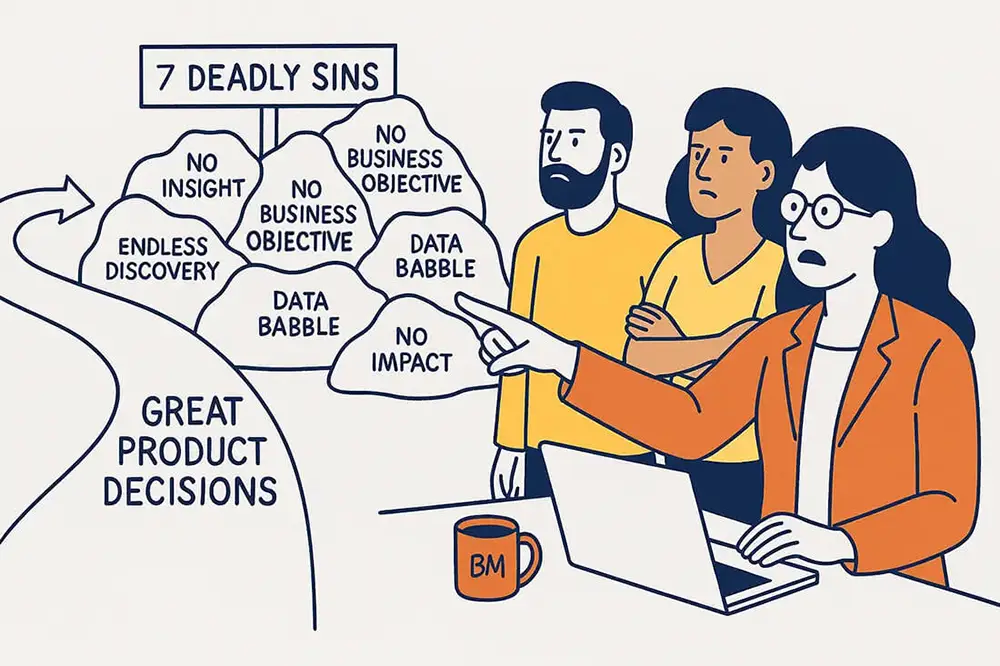
Unfortunately, poor discovery means that all discovery gets a bad name. Leaders remember that ‘waste of time discovery project’ and assume that all discovery is tarred with the same brush. But it doesn’t have to be this way. There are common symptoms of poor discovery that are what cause businesses and business leaders to lose confidence, and they can be avoided. I call these the 7 deadly sins of discovery.
The 7 Deadly Sins Of Discovery
In every company where discovery has a bad name, I can almost guarantee that the company or leaders within it have experienced one or more of these sins before. In the worst cases they have experienced them all!
Gradually (or sometimes very suddenly) the 7 deadly sins of discovery chip away at the observable value of discovery and together they precede its long-term downfall. They are:
- Endless discovery: Discovery that never ends and results in little new information. Every discovery ‘project’ leads to another and another variation of the previous one. When discovery is treated as a blank cheque it never has to deliver anything back to the business that supports it.
- No business objective: Discovery exists in the absence of business content and is framed purely from a product perspective (if it is framed at all). Discovery has no relation to business strategy or what the business needs to succeed in meeting its goals.
- Biased discovery: When discovery is used to prove personal biases, it does not actually want to discover anything at all! Research and data are never objective. Who collects, analyses and interprets them matters.
- No insight: Data is not the same thing as insight. Copious volumes of data can be produced and never be used by the business; this is usually because there is no usable insight in the data.
- No impact: Even if there is insight from discovery, it may not be relevant to the business. If there is nothing the business can do with the insight, it cannot create impact. Insight plus relevant context allows for impact.
- Data Babble: Discovery relies not only on the research being done and analysed for insight but on those insights being communicated to the right people in the right way. Data babble is where we communicate data for data’s sake, not for the audience’s sake.
- No decisions: Ultimately the success of discovery is in the quality of the decisions it enables. If every discovery initiative ends with ‘let’s wait and see’ discovery is not fulfilling its purpose.
But the good news is, the 7 deadly sins are easily avoided with practical steps that improve our discovery skills and secure business confidence every step of the way. This is part 1 of a 6-part series where we will explore practical tips to vastly reduce the likelihood of falling victim to one of the 7 deadly sins.
Part 2 of the series will start with the sin of Endless discovery. What is it, how does it destroy business confidence and what is one simple way we can set ourselves up to avoid it?

